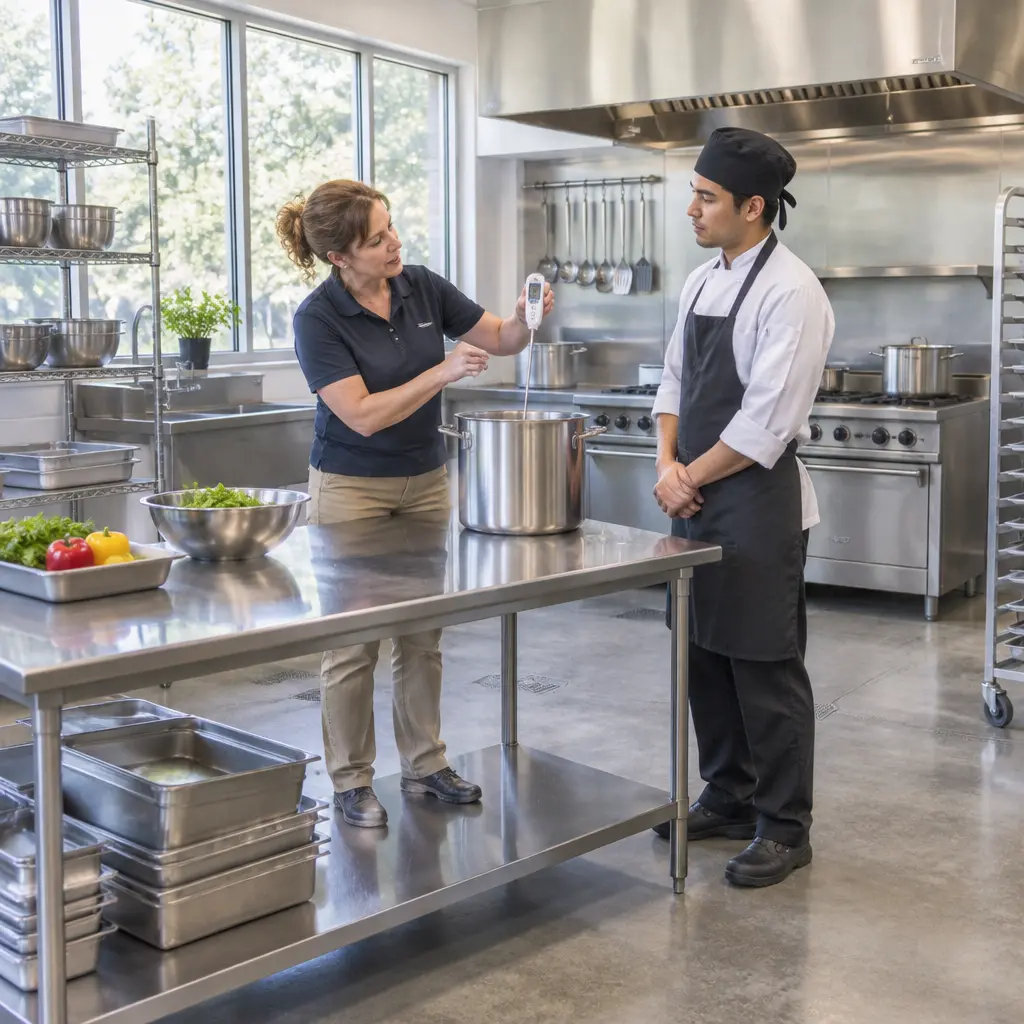
A food safety training program for new hires is a structured process for teaching employees how to handle, prepare, store, and serve food safely. The U.S. Food and Drug Administration’s 2022 Food Code provides a model for retail and food-service safety practices, while the Centers for Disease Control and Prevention estimates that foodborne illness causes 48 million illnesses, 128,000 hospitalizations, and 3,000 deaths in the United States each year. A sound onboarding program turns those risks into practical routines: assess the workplace, teach essential controls, demonstrate tasks, verify competence, and refresh training as duties or risks change.
Program design and food safety training for new hires
A food safety training program is an employer-organized system of instruction, practice, and assessment that helps workers prevent contamination and follow applicable food laws. The FDA Food Code is a model code—not automatically a law everywhere—so employers should check their state and local requirements, including rules for certified food protection managers and food-handler training. Build the program around actual job tasks, the facility’s written procedures, and the hazards employees may encounter.
The FDA identifies five major risk factors associated with foodborne illness outbreaks in retail food settings: improper holding temperatures, inadequate cooking, contaminated equipment, food from unsafe sources, and poor personal hygiene. These provide a practical framework for deciding what new hires must learn first. For example, a cashier who handles only packaged food needs different task instruction from a cook who cools soups and prepares ready-to-eat meals.
Assess roles, hazards, and local requirements
A training needs assessment identifies the work each employee will perform, the hazards attached to it, and the controls required by law and company policy. List roles such as receiving, preparation, cooking, cooling, dishwashing, and service; then map each role to relevant procedures. Confirm requirements with the local health department because adoption and enforcement of the FDA Food Code vary by jurisdiction.
Use the facility’s food safety plan, standard operating procedures, and any applicable Hazard Analysis and Critical Control Point (HACCP) procedures to shape instruction. Where a task has a critical limit—such as a required cooking temperature—make the limit, measuring method, corrective action, and documentation clear. Training should also cover the site’s allergen controls and employee illness-reporting rules.
Set learning objectives and training milestones
Learning objectives describe observable actions a worker must perform, rather than broad goals such as “understand food safety.” Examples include demonstrating effective handwashing, using a calibrated thermometer correctly, separating raw poultry from ready-to-eat food, and explaining what to do after a temperature check falls outside the approved limit.
Organize learning into stages: before independent work, during supervised practice, and during follow-up. Give employees the instruction they need before assigning a task, then have a qualified trainer observe them doing it. This staged approach makes training specific to the job and lets supervisors address mistakes before they become routine.
Core food safety training for new hires
Core food safety training covers the behaviors that prevent biological, chemical, and physical hazards from reaching customers. CDC identifies contaminated food and unsafe handling as contributors to foodborne illness, while the FDA Food Code translates many preventive practices into operational standards. Teach employees the reason for each control as well as the exact procedure: workers are more likely to respond correctly when they recognize what can go wrong.
Personal hygiene and employee illness
Personal hygiene training explains how workers prevent pathogens from transferring from people to food, utensils, and food-contact surfaces. Demonstrate handwashing at the designated sink, including when it is required; explain glove use and why gloves do not replace handwashing; and cover clean clothing, hair restraints, and limits on eating or handling personal items in food-preparation areas.
Employees also need to know how and when to report symptoms or diagnoses covered by applicable rules, and whom to notify before starting or returning to work. The FDA Food Code includes provisions on employee health, restriction, and exclusion, but the applicable requirements depend on local adoption. Make reporting straightforward and nonpunitive so workers do not feel pressured to conceal illness.
Time, temperature, and thermometer use
Time-and-temperature control means keeping food within required limits during receiving, storage, preparation, cooking, cooling, reheating, and hot or cold holding. Teach staff to use the facility’s approved reference chart and a suitable food thermometer, rather than relying on appearance, cooking time alone, or equipment settings. Demonstrate correct thermometer placement, cleaning and sanitizing between measurements, calibration checks, and recording results where required.
The FDA Food Code contains detailed temperature and time provisions, including cooking, cooling, and holding controls. Exact requirements can depend on the food and the jurisdiction’s adopted code. Train employees to stop and tell a supervisor when a reading is outside the facility’s limit, then follow the documented corrective action instead of guessing or changing records.
Cross-contamination, cleaning, and sanitizing
Cross-contamination occurs when harmful microorganisms or allergens move between food, people, equipment, or surfaces. Show new hires how to separate raw animal foods from ready-to-eat foods; use designated equipment or clean and sanitize between tasks; store foods to prevent drips; and handle utensils safely. Teach cleaning and sanitizing as separate steps: cleaning removes soil, while sanitizing reduces microorganisms on an appropriately cleaned surface.
Practical training should include the correct sanitizer concentration and contact time specified by the product label and site procedure, along with safe chemical storage. Employees should know how to use test strips when required and what to do if a solution is too weak, too strong, or contaminated. The FDA’s retail risk-factor work identifies contaminated equipment as one of the key conditions associated with foodborne illness outbreaks.
Allergen awareness and customer communication
Allergen training teaches employees to prevent unintended allergen exposure and to handle customer questions accurately. The FDA identifies nine major food allergens in the United States: milk, eggs, fish, crustacean shellfish, tree nuts, peanuts, wheat, soybeans, and sesame. Employees should learn how allergens are identified in ingredients and recipes, how to prevent cross-contact, and how to escalate an uncertain question rather than make an unsupported assurance.
Connect front-of-house and kitchen procedures. A server should know whom to consult about an ingredient, while the kitchen team should understand the site’s steps for preparing an allergen-sensitive order, including clean hands, utensils, surfaces, and equipment as applicable. The FDA Food Code and local rules may address allergen notification, so verify the requirements that apply to the establishment.
Practical instruction and competency verification
Effective food safety instruction combines explanation, demonstration, guided practice, and assessment. A signed attendance sheet shows that a session occurred; it does not prove an employee can carry out a task safely. The National Restaurant Association’s ServSafe materials and other recognized programs can supplement workplace instruction, but training still needs to reflect the establishment’s equipment, menu, procedures, and local rules.
Use demonstrations and supervised practice
A demonstration makes an otherwise abstract procedure visible. A trainer can model handwashing, thermometer calibration, safe cooling documentation, or sanitizer testing, then ask the new hire to repeat the task while explaining key decisions. Supervised practice should take place with the tools and conditions employees will actually encounter, not only in a classroom or online module.
Use teach-back to check understanding: ask the worker to describe or show the procedure in their own words. Correct mistakes immediately and respectfully, then repeat the task until the employee meets the standard. If a worker is not yet competent, keep the task supervised and provide additional coaching before authorizing independent work.
Assess performance and document training
Competency assessment checks whether an employee can apply required knowledge and skills. Use brief quizzes for key concepts, direct observation for practical tasks, and scenario questions for decisions such as responding to an unsafe temperature or an allergen request. A simple scoring rubric can record whether the task was performed correctly, whether prompting was needed, and whether follow-up is required.
Maintain a training record with the employee’s name, role, date, topics covered, trainer, assessment result, and any coaching or retraining. Keep records in line with company policy and applicable rules. Documentation helps managers track completion, identify recurring gaps, and show that the business has a consistent process rather than relying on informal memory.
Refresher training and program improvement
Food safety training is an ongoing management process, not a one-time orientation. Procedures can change when a menu, supplier, piece of equipment, or local requirement changes; staff can also develop unsafe habits if performance is not observed. The FDA’s Food Code is updated periodically as a model, so managers should review relevant regulatory changes and confirm whether their jurisdiction has adopted them.
Schedule refreshers and retraining
Refresher training reinforces high-risk practices and addresses changes in work. Schedule short reviews at regular intervals and provide targeted retraining after a procedure change, an observed lapse, a failed assessment, or a temperature or sanitation deviation. The schedule should reflect risk and performance rather than treating every topic as equally urgent.
Use shift meetings, brief demonstrations, and job aids near the point of work to reinforce formal onboarding. Keep materials readable and available in languages employees understand. A translated handout is most useful when paired with a trainer who can verify that the worker understands and can demonstrate the procedure.
Measure whether training is working
Program evaluation compares training activity with workplace performance. Track completion and assessment results, then review relevant operational indicators such as temperature-log errors, sanitation checks, observed handwashing, corrective actions, and inspection findings. A change in one metric does not by itself prove training caused the result, but patterns can help managers locate weak procedures or topics that need clearer instruction.
For example, if repeated temperature records show missing or implausible readings, the response should be more than another reminder. Observe how employees measure food, verify that thermometers are available and working, clarify the recording procedure, and reassess competence. This turns operational evidence into a targeted improvement cycle.
Conclusion: Make food safety part of every new hire’s work
A reliable food safety training program begins with role-based hazard assessment, teaches core controls for hygiene, illness reporting, temperature, contamination, cleaning, and allergens, and confirms skills through supervised practice. Records and follow-up help managers identify gaps, while refreshers keep procedures current. Because foodborne illness remains a substantial public health concern, employers should review local requirements, train workers before they perform tasks independently, and routinely observe whether safe practices are followed.
Start by mapping each job to its food safety tasks, checking the applicable health code, and assigning a qualified trainer. Then create a practical onboarding checklist and review performance indicators regularly. For further guidance, consult the FDA Food Code, the FDA’s retail food protection resources, CDC food safety information, and your local health department.
Sources: Centers for Disease Control and Prevention, “Foodborne Germs and Illnesses,” https://www.cdc.gov/food-safety/about/; U.S. Food and Drug Administration, Food Code 2022, https://www.fda.gov/food/fda-food-code/food-code-2022; U.S. Food and Drug Administration, “Retail Food Protection: Employee Health and Personal Hygiene Handbook,” https://www.fda.gov/food/retail-food-industryregulatory-assistance-training/employee-health-and-personal-hygiene-handbook; U.S. Food and Drug Administration, “FDA Report on the Occurrence of Foodborne Illness Risk Factors in Selected Institutional Foodservice, Restaurant, and Retail Food Store Facility Types,” https://www.fda.gov/food/retail-food-protection/fda-report-occurrence-foodborne-illness-risk-factors-selected-institutional-foodservice; U.S. Food and Drug Administration, “Food Allergies,” https://www.fda.gov/food/food-labeling-nutrition/food-allergies; National Restaurant Association, ServSafe Food Handler, https://www.servsafe.com/ServSafe-Food-Handler.