
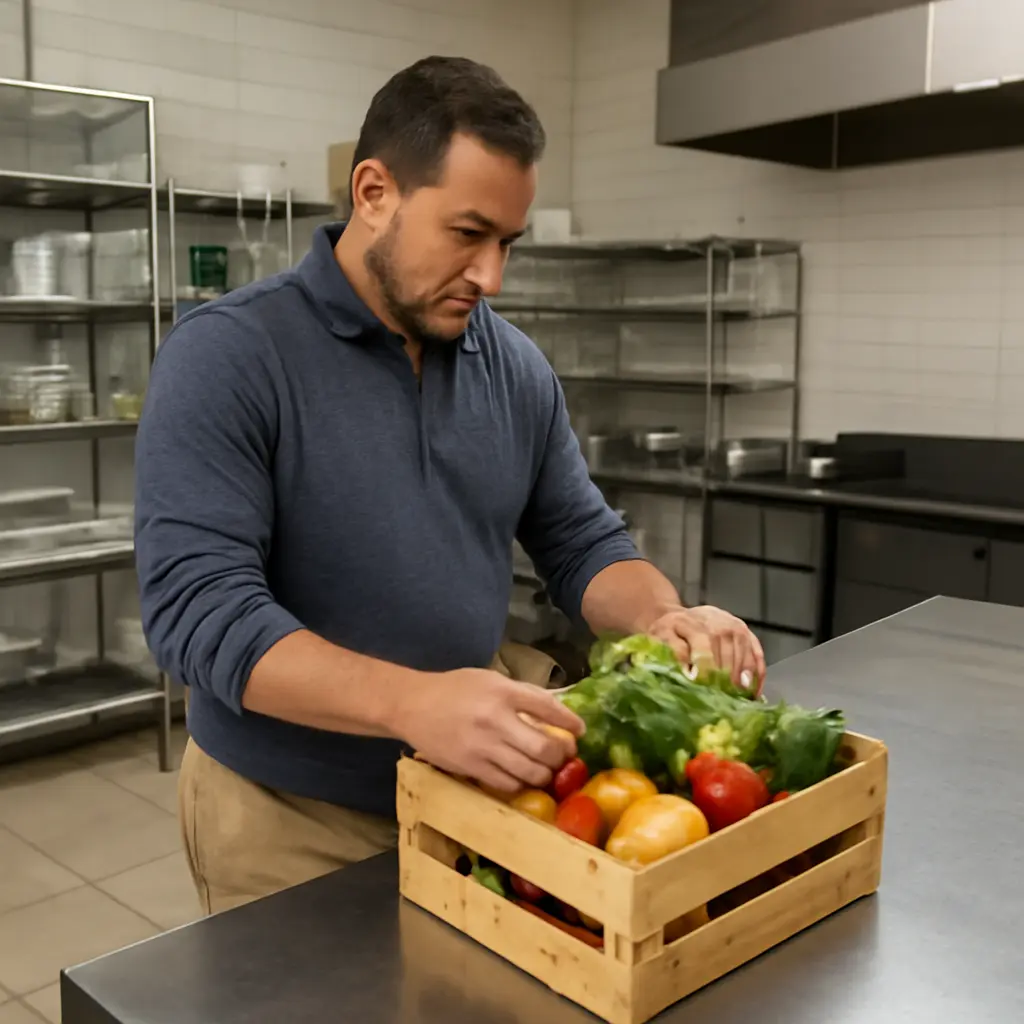
Food waste is edible food that is discarded, left uneaten, or otherwise removed from the human food supply. Companies waste resources on low-impact food problems when they invest time, money, and staff attention in visible but marginal fixes while overlooking the larger causes of loss. The scale is substantial: the United Nations Environment Programme (UNEP) estimates that 1.05 billion tonnes of food were wasted at retail, food-service, and household levels in 2022, about 19% of food available to consumers. For businesses, five recurring traps are cosmetic perfection, isolated date-label confusion, poorly targeted rescue efforts, measurement without action, and sustainability claims that substitute for operational change. Better prioritization starts with measuring where losses occur, valuing food and resources together, and directing effort toward interventions with meaningful reductions.
How companies misallocate resources on low-impact food problems
A low-impact food problem is not necessarily trivial. It is a problem whose likely reduction in total food loss is small relative to the resources required or to the benefits available from other interventions. The World Resources Institute (WRI) describes food loss and waste as a supply-chain issue that can be addressed through measurement, target-setting, and action; its “Target-Measure-Act” approach emphasizes diagnosing material losses before selecting solutions. In practice, companies often reverse that sequence, funding a highly visible fix before establishing how much food it can save.
The distinction matters because wasted food also represents wasted land, water, energy, labor, packaging, refrigeration, and transport. UNEP reports that food loss and waste generate an estimated 8–10% of global greenhouse-gas emissions. That figure covers the wider global problem, not the share attributable to any one company or intervention, but it underscores why firms should compare options by expected impact rather than publicity. The five traps below illustrate how to make that comparison.
1. Treating cosmetic produce standards as the main problem
Cosmetic produce standards are appearance requirements for size, shape, color, or surface condition. They can become a low-impact priority when companies concentrate on “ugly” produce campaigns while larger, less photogenic losses—such as overproduction, spoilage, and unsold inventory—remain unmeasured. A blemished fruit is not automatically wasted: it may already be sold through processing, food service, or value retail channels.
The Food and Agriculture Organization of the United Nations (FAO) has long highlighted that losses occur at multiple stages, from production and handling through processing and distribution. The relevant question for a buyer is therefore not simply whether produce looks imperfect, but whether its specifications cause avoidable, measurable rejection and what happens to rejected goods. Companies should compare rejection rates and destinations by commodity, supplier, and season before funding a broad cosmetic-rescue campaign.
2. Focusing on date-label confusion without fixing inventory practices
Date-label confusion arises when consumers or staff interpret quality dates as safety deadlines. In the United States, the Food and Drug Administration (FDA) and U.S. Department of Agriculture (USDA) explain that, with the exception of infant formula, date labels are generally not federally required indicators of food safety; “Best if Used By” commonly communicates quality. Rules and wording vary by jurisdiction and product, so businesses must follow applicable food-safety requirements.
Clarifying labels can help, but it is a narrow intervention if a company’s larger losses come from inaccurate forecasts, oversized orders, poor stock rotation, or weak markdown timing. The U.S. Government Accountability Office (GAO) has identified inconsistent date-label practices as a source of consumer confusion and recommended clearer, more consistent language. For companies, the practical lesson is to pair label improvements with first-expiring-first-out handling, demand planning, and safe, timely price reductions—not to treat a label redesign as a substitute for inventory control.
3. Overinvesting in food donation logistics while preventing little surplus
Food donation is the redistribution of edible surplus to people or organizations that can use it. It is valuable when suitable food would otherwise be discarded, but it is not the same as preventing surplus. A company may spend heavily on collection, sorting, and transport while leaving routine overproduction or procurement errors untouched. Donation also requires attention to food safety, cold-chain capacity, recipient demand, and the costs of handling small or irregular loads.
The U.S. Environmental Protection Agency (EPA) ranks preventing food waste and feeding people among preferred approaches in its wasted-food hierarchy, ahead of options such as composting and landfill disposal. That hierarchy does not diminish donation; it helps order decisions. Businesses should first identify avoidable surplus, then build reliable donation routes for edible food that remains, and report both quantities prevented and quantities redistributed so that rescue activity does not mask persistent overproduction.
4. Measuring what is easy instead of what is material
Food-waste measurement is the systematic recording of the amount, type, cause, and destination of food that leaves a company’s intended human-consumption pathway. A low-impact measurement program weighs only convenient waste streams—such as kitchen scraps at one site—or tracks participation in a campaign without establishing a baseline. Such data can look precise while missing the largest losses in purchasing, storage, production, or distribution.
WRI’s Food Loss and Waste Accounting and Reporting Standard provides a framework for defining and reporting food loss and waste consistently. Companies can use that discipline to establish a baseline by product and operational stage, then calculate reductions against a comparable period. UNEP’s Food Waste Index Report 2024 estimates that food service accounted for 28% of consumer-level food waste in 2022, while retail accounted for 12%; these global shares are not a forecast for an individual business, but they show why sector and process context matter. A retailer, manufacturer, and restaurant should not assume they have the same highest-impact opportunity.
5. Prioritizing visible sustainability claims over operational change
A sustainability claim is a public statement about environmental performance, such as a pledge to reduce food waste or a campaign promoting a particular product. It becomes a resource trap when marketing, packaging, or reporting receives more attention than changes to forecasting, product design, purchasing, storage, and production. Communications can support progress, but they cannot establish progress by themselves.
The European Commission’s food-waste policy work and the U.S. EPA’s food-recovery guidance both point toward prevention and measurement as core parts of an effective response. A credible corporate claim should specify its baseline, scope, time frame, and method, and distinguish prevention from diversion. For example, diverting scraps to compost can reduce disposal impacts, but it should not be reported as though the company prevented the food from becoming waste. Independent review and transparent progress reporting help keep reputational incentives aligned with real reductions.
How to rank food-waste actions by impact
A practical prioritization process compares each proposed action’s expected food reduction with its cost, feasibility, and wider resource benefits. The following sequence adapts the measurement-first logic used by WRI and the EPA’s wasted-food hierarchy:
- Map losses across procurement, production, storage, sales, and disposal, including food type, quantity, and destination.
- Set a baseline and identify the few products, sites, or processes responsible for the largest share of avoidable waste.
- Estimate the reduction each intervention can deliver, alongside labor, equipment, food-safety, and implementation costs.
- Prioritize prevention, such as better forecasting, right-sized production, improved storage, and purchasing changes.
- Redistribute safe edible surplus where prevention is not yet possible, then use recycling or disposal options for remaining material.
- Track actual results against the baseline and revise interventions that do not deliver meaningful reductions.
A useful chart for an internal review would plot interventions by expected tonnes prevented on one axis and implementation cost on the other, with food-safety feasibility shown as a separate marker. This makes it easier to distinguish a high-visibility, low-yield project from a less visible operational fix with stronger potential.
Conclusion: direct company resources toward measurable prevention
Companies waste resources on low-impact food problems when they overemphasize cosmetic standards, label confusion, donation logistics, easy-to-collect data, or public-facing claims while neglecting larger operational causes. UNEP’s estimate of 1.05 billion tonnes of consumer-level food waste in 2022 shows the scale of the broader challenge, while WRI’s measurement-first approach and the EPA’s wasted-food hierarchy offer practical ways to set priorities. Businesses should establish a credible baseline, identify material loss points, prevent avoidable surplus first, and report donation and diversion separately from prevention. The next step is straightforward: choose one high-volume product or process, measure its losses, test a targeted intervention, and publish the result with a clear method.
Sources: United Nations Environment Programme, Food Waste Index Report 2024, https://www.unep.org/resources/publication/food-waste-index-report-2024; United Nations Environment Programme, Food Waste, https://www.unep.org/thinkeatsave/about; World Resources Institute, Target-Measure-Act: A Guide to Reducing Food Loss and Waste in Company Operations, https://www.wri.org/research/target-measure-act; World Resources Institute et al., Food Loss and Waste Accounting and Reporting Standard, https://www.wri.org/research/food-loss-and-waste-accounting-and-reporting-standard; Food and Agriculture Organization of the United Nations, The State of Food and Agriculture 2019: Moving Forward on Food Loss and Waste Reduction, https://www.fao.org/3/ca6030en/ca6030en.pdf; U.S. Food and Drug Administration, Food Loss and Waste, https://www.fda.gov/food/consumers/food-loss-and-waste; U.S. Government Accountability Office, Food Loss and Waste: Building on Existing Federal Efforts Could Help to Achieve National Reduction Goal, https://www.gao.gov/products/gao-19-407; U.S. Environmental Protection Agency, Wasted Food Scale, https://www.epa.gov/sustainable-management-food/wasted-food-scale; U.S. Environmental Protection Agency, Food Recovery Hierarchy, https://www.epa.gov/sustainable-management-food/food-recovery-hierarchy; European Commission, Food Waste, https://food.ec.europa.eu/food-safety/food-waste_en.
